Venomous spider and arthropod mitigation in Tucson requires structural understanding of Sonoran Desert habitats. Desert spiders such as the Western black widow and the Arizona brown spider seek sheltered microclimates…
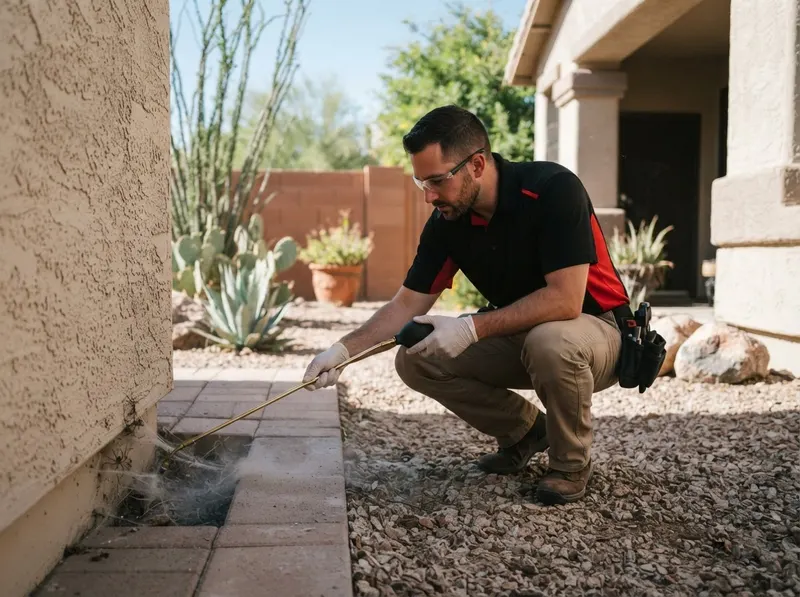
Venomous spider and arthropod mitigation in Tucson requires structural understanding of Sonoran Desert habitats. Desert spiders such as the Western black widow and the Arizona brown spider seek sheltered microclimates when summer temperatures exceed 100 degrees Fahrenheit or winter evening temperatures dip toward freezing. In historic neighborhoods like Armory Park, El Presidio, and Dunbar Spring, raised wooden foundations, stone footings, and crawl spaces create prime dark voids for web placement and egg incubation. Conversely, foothill properties bordering wild desert washes, such as homes along the Catalina Foothills, broad acreages near Saguaro National Park East, or properties near the Sabino Canyon Recreation Area, regularly encounter giant desert centipedes and venomous spiders migrating from undisturbed natural terrain directly into decorative rip-rap and dry-stacked retaining walls.
Selecting target-specific mitigation avoids the pitfalls of standard over-the-counter pyrethroid sprays, which quickly break down under intense ultraviolet radiation and fail to penetrate dense egg sacs. A standalone spider barrier service suits homes experiencing localized web clusters in water meter boxes, garage corners, and patio overhangs. For homes situated near active desert washes or heavy native xeriscaping in Civano or Broadmoor-Broadway, integrating exterior microencapsulated perimeter barriers with physical exclusion sealing provides continuous defense against migrating prey insects that attract arachnids. The operational trade-off centers on perimeter clearance: broad residual applications require pulling back dense ground cover and clearing stored lumber 12 to 18 inches away from stucco walls, requiring minor mechanical site preparation to achieve complete structural defense.
Crenvia Bug Specialists delivers targeted Sonoran defense without mandatory 12-month auto-renewing service contracts. Interior applications focus strictly on baseboard crevices, utility pipe entry collars, and structural seams rather than broad broadcast misting, ensuring treated surfaces remain safe around companion animals once dry, typically within 60 to 90 minutes. Technicians inspect brick voids in Blenman-Elm, vintage adobe block lines in Sam Hughes, and exterior irrigation enclosures across Pima County to eradicate active nesting populations at the source.
Every job gets a firm, written price after a free on-site visit.
Tell us about your venomous spider and arthropod mitigation job in Tucson and we'll send a clear, written quote, usually the same day.
 Crenvia Bug Specialists