Heterotermes aureus is the primary structural pest throughout southern Arizona, foraging through calcareous desert dirt and penetrating micro-fissures in post-tension foundations, brick stems, and slab joints. In…
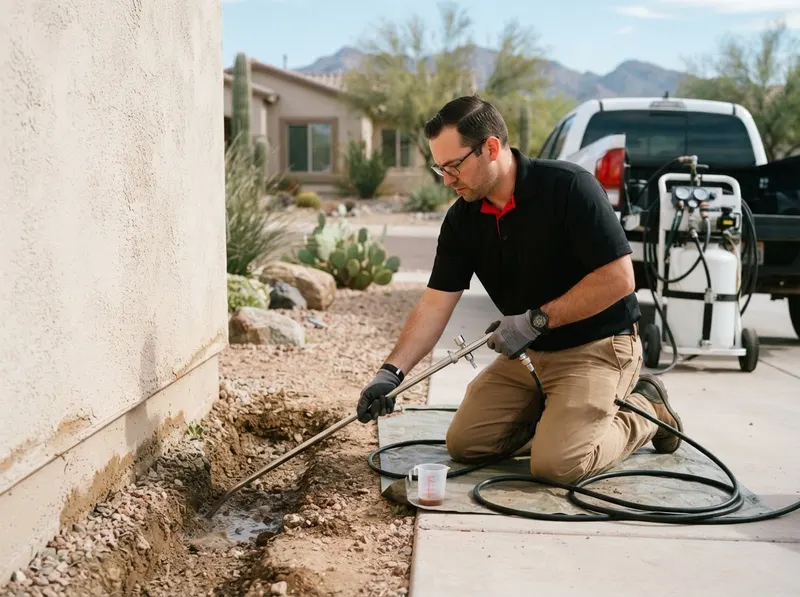
Heterotermes aureus is the primary structural pest throughout southern Arizona, foraging through calcareous desert dirt and penetrating micro-fissures in post-tension foundations, brick stems, and slab joints. In historic districts like El Presidio, Dunbar Spring, and Armory Park, structures frequently feature fieldstone or mud-adobe base footings that lack physical moisture barriers, allowing subterranean foraging tubes to climb undetected behind exterior stucco. Contemporary developments in Civano and foothill custom builds across the Catalina Foothills rely on monolithic concrete slabs; here, subterranean termites enter through expansion joints or bath-trap openings concealed under tile flooring. A continuous chemical soil barrier saturates the earth 6 inches wide and 6 inches deep around the foundation, introducing a non-repellent compound that worker termites track through the subterranean gallery network, neutralizing the colony queen rather than simply turning foraging workers toward untreated crawlspaces.
Decision guidance relies on structural construction and visible mud shelter tubes. For active exploratory tubes emerging from expansion joints in Broadmoor-Broadway or Blenman-Elm homes, localized surface sprays fail because subterranean termites maintain an underground nest deep below the desert caliche layer. Liquid barrier treatments require systematic trenching around native soil edges, plus precision drilling through attached masonry features like paver patios, porches, and slab driveways. The trade-off is mechanical site disturbance: attached concrete slabs require core drilling at 12-inch spacings to treat the dirt underneath, which technicians then patch with matching masonry mortar. When compared to above-ground termite baiting stakes, soil barriers yield continuous, immediate perimeter protection that lasts multiple years in dry desert alkaline soils, eliminating reliance on mandatory 12-month auto-renewing monitoring contracts.
Soil condition directly impacts application volume and termiticide absorption. Heavy caliche and clay layers common across midtown Tucson, including Sam Hughes, slow chemical dispersion, requiring high-pressure rodding equipment to reach depths of 24 to 48 inches beside foundation footings. In coarse sandy washes near Sabino Canyon Recreation Area, termiticide distributes rapidly through the soil matrix. Technicians measure perimeter linear footage, account for attached slab setbacks, and formulate the barrier to prevent chemical migration into ornamental vegetation or domestic pet zones.
Every job gets a firm, written price after a free on-site visit.
Tell us about your subterranean termite soil barrier treatments job in Tucson and we'll send a clear, written quote, usually the same day.
 Crenvia Bug Specialists